
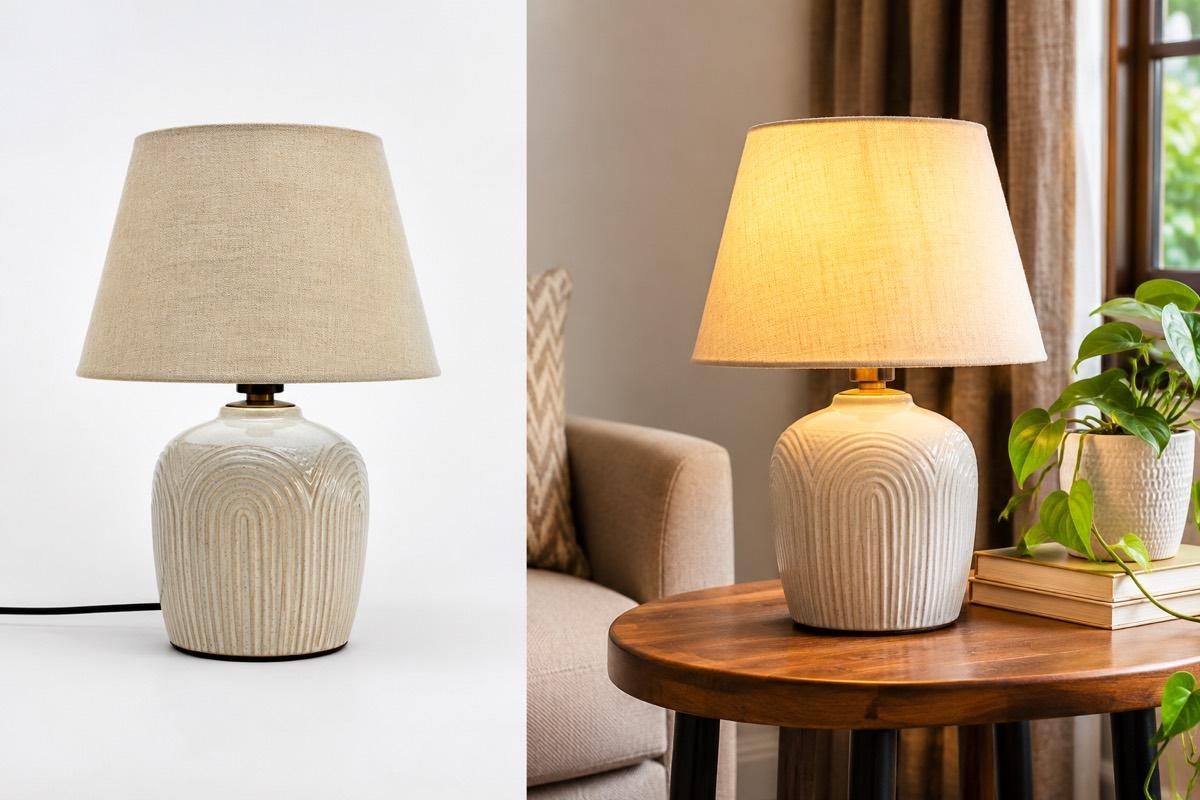
Every product listing faces the same question: should the photo show the product alone on a clean background, or in a real setting with people and props? The honest answer is that you need both. What matters is where each type goes.
This article explains what studio and lifestyle photos each do well, where marketplaces force your hand, and how to mix them across marketplaces, your own website and social media.
What we mean by each
Studio photos show the product on its own against a plain background, usually white, grey or a light neutral. The lighting is even, there are no props and nothing competes with the product. Packshots and white background main images are studio photos.
Lifestyle photos show the product in context: a kurta on a model in a courtyard, a lamp on a bedside table, a serum on a bathroom shelf, headphones on someone at a desk. They tell the buyer how the product fits into their life.
Between the two sit on-model studio shots, such as an apparel model on a clean backdrop. They carry some of the emotional pull of lifestyle photos with the clarity of a studio shot.
What each type does best
| Studio | Lifestyle | |
|---|---|---|
| Shows exact product and colour | Strong | Moderate |
| Meets strict marketplace rules | Strong | Often not allowed as main image |
| Shows scale and use | Weak | Strong |
| Builds mood and brand | Weak | Strong |
| Easy to keep consistent | Strong | Harder |
| Works in a crowded search grid | Strong | Depends on composition |
Studio photos answer "what exactly am I buying?" Lifestyle photos answer "why would I want it?" Buyers need both answers before they pay.
Marketplaces: studio first, lifestyle second
On marketplaces, the main image is usually decided for you.
- Amazon and Flipkart require a pure white background for the main image. Lifestyle images are welcome in the additional gallery slots.
- Meesho is more relaxed, accepting white, light neutral or clean lifestyle backdrops as long as there is no text or contact information.
- Myntra is built around on-model fashion photography in portrait framing, with clean studio or lifestyle backdrops.
For the details on a more relaxed marketplace, see our Meesho product photo guide.
On a marketplace, the main image wins the click and the gallery wins the sale. Use the main image for clarity and the gallery for context.
A typical marketplace gallery
- Studio main image on the required background
- Second angle, studio
- Detail or close-up, studio
- Lifestyle image showing the product in use
- Scale shot, in hand or next to a familiar object
- A second lifestyle or on-model image
D2C websites: brand decides
On your own Shopify or D2C store, there are no marketplace rules for the background. That freedom is useful, but it is also where many brands lose consistency.
- Collection and category pages usually look best with consistent studio or on-model studio shots. When every product is shot the same way, the grid looks tidy and products are easy to compare.
- Product pages can open with a studio shot and then move into lifestyle images further down the gallery.
- Homepage banners and campaign pages are where lifestyle imagery shines.
Our Shopify product images guide covers collection-page consistency in more detail.
Social media: lifestyle leads
On Instagram, Facebook and WhatsApp, nobody is searching for a product with a filter. They are scrolling. Lifestyle photos, on-model shots and short videos stop the scroll better than a white packshot.
That said, studio images still have a place on social: carousel slides showing product details, catalogue posts, and sale posters, where a clean cut-out of the product sits on a designed background.
Category matters too
| Category | Studio emphasis | Lifestyle emphasis |
|---|---|---|
| Apparel | On-model studio for catalogue | Outdoor and indoor scenes for social |
| Jewellery | Close-ups for detail | Worn shots for scale |
| Beauty | Packshots and swatches | Applied shots, shelf scenes |
| Home | Packshot for dimensions | Room scenes are essential |
| Electronics | Clean packshots, ports and buttons | In-use at desk, on the go |
| Food and beverage | Pack and label shots | Serving and pouring scenes |
Home decor and furniture rely on lifestyle more than most categories, because buyers struggle to judge size and style from a packshot alone. Electronics lean the other way: buyers want to see every port and button clearly.
The consistency trap with lifestyle photos
Lifestyle photos are harder to keep consistent than studio photos. Different rooms, different light and different props quickly make a catalogue look patchy. A few rules help:
- Choose two or three scene styles and reuse them
- Keep the same model or small set of models across a collection
- Match the colour mood of scenes to your brand
- Do not let props overpower the product
The honesty rule applies to both
Whatever style you choose, the product must look exactly like what the buyer receives. A lifestyle scene can show a mood, but it must not change the product's colour, size or finish.
A simple starting mix
If you are unsure where to begin, start with one clean studio main image, two or three studio detail shots and at least one lifestyle or on-model image for every product. Then watch which listings get clicks and questions, and add more lifestyle images where buyers seem unsure about size, use or style.
How VisionLab helps
VisionLab's AI Photoshoot creates both types from a single phone photo. Studio shots give clean packshots for marketplace main images, while lifestyle and on-model shots place your product in real-world settings or on a model, across apparel, jewellery, beauty, home, electronics, accessories and food categories. Pick a target marketplace and the output follows that platform's background and framing. The Marketing Poster maker turns the same product into sale and festive posters for social media.
Start free with 5 free credits, no card needed.
Frequently asked questions
Can I use a lifestyle photo as my main image on Amazon or Flipkart?
Generally no. Both require a pure white background for the main image. Use lifestyle photos in the additional gallery slots instead.
Which is better for social media, studio or lifestyle?
Lifestyle and on-model images usually stop the scroll better on social media. Studio images still work for detail slides, catalogue posts and sale posters.
What should my D2C collection page use?
Consistent studio or on-model studio shots usually work best, because a uniform grid makes products easy to compare. Save lifestyle images for product galleries and banners.
Which product categories need lifestyle photos the most?
Home decor and furniture rely heavily on lifestyle scenes because buyers need to judge size and style. Apparel and jewellery benefit from on-model and worn shots.